


Ответь на 5 вопросов
и узнай свои реальные шансы на получение визы всего за несколько минут.


Шаг 1 из 6
Шаг 6 из 6
Последний шаг!
Укажите контакты и получите результат
Отправляя форму, вы соглашаетесь на обработку персональных данных.
Шаг 6 из 6
Анализируем ваши ответы...
Проверяем введённые данные
China Business Visa via Poland — Turnkey with Visa Agency
Travelling to China for negotiations, an exhibition, or a business meeting? We handle the entire process — from business documents to the visa in your passport. We understand the specifics of applying from Poland for Ukrainians, Belarusians, and other nationalities.
WHAT DOCUMENTS
ARE NEEDED FOR THE VISA
Basic package
- International passport valid for at least 6 months
- Proof of legal stay in Poland (visa, residence card, PESEL UKR)
- Completed visa application form (Chinese Embassy form V.2013)
- Photo according to Chinese consulate requirements
- Invitation letter from a Chinese company or organization
- Letter from your employer confirming the business trip
- Round-trip flight reservation
- Hotel booking
- Motivation letter
- Business trip itinerary
Depending on your situation
- Employees: employment certificate stating position, salary and work experience, employment contract, employer confirmation of the business trip, confirmation of who pays for the trip
- Entrepreneurs and business owners: company registration documents, tax reports, contracts with Chinese partners, business correspondence with the Chinese side
- Freelancers: contracts with clients, bank statements confirming stable income, registration as a sole proprietor or self-employed person
Additional documents
- Previous visas to China, Japan, the USA, and the United Kingdom
- Travel history within EU countries
- Documents proving family ties in Poland or Europe
- Bank statement for the last 3–6 months
- Property ownership documents or rental agreement in Poland
- Conference or business event program
- Contracts and business correspondence with the Chinese side
- Registration for a business event in China
- Sponsorship letter from a Chinese company
Consultation
We analyze your business situation: type of employment, purpose of travel, and company documents. We choose the application strategy and honestly assess your chances before the first payment.
Business document preparation
We help correctly prepare the invitation letter from the Chinese company and the letter from your employer — with the right wording to answer all embassy questions. The Chinese Embassy has strict requirements for business documents, including the company stamp and signature of an authorized person.
Application form completion
We complete the Chinese Embassy V.2013 application form. The form contains detailed questions about business ties, itinerary, and finances. Every field is checked twice — a mistake can lead to delays or refusal.
Preparation of the full document package
We prepare the full package: application form, business invitation, employer letter, financial documents, motivation letter, business trip itinerary, hotel and flight reservations, and everything else required for your situation.
Submission to the visa center
Documents are submitted in person at the Chinese Visa Application Service Center in Warsaw (CVASC). We support the submission and help at every stage. We can also submit the documents on your behalf — in this case, after receiving the visa, we will send your passport to your address by courier.
Application review
Standard processing time is 4 to 7 business days. Urgent processing is available for an additional fee if needed.
Receiving the passport with the visa
The passport with the visa sticker is collected at the visa center or sent by courier. The visa is placed directly into the passport.
Processing and issuance timeline:
- Case preparation with us: from 3 to 14 days
- Waiting for the submission date: from 2 to 10 days
- Embassy processing time: from 4 to 7 business days
- Urgent processing: 2–3 business days (additional fee)
- Receiving the passport with visa: 2–5 days after approval
Validity period and entry rules:
- Single-entry visa validity: 3 months from the date of issue
- Multiple-entry visa validity: up to 2 years
- Length of stay per entry: up to 30 or 60 days depending on the visa type
- Working for a Chinese company on a business visa is prohibited
- The visa is placed directly into the passport
- Entry is possible only within the visa validity period
Chinese Visa Application Service Center in Warsaw (CVASC)
Embassy of China in Warsaw
YOUR
VISA
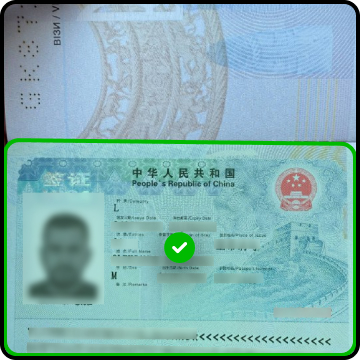
The result you came for — an approved visa in your hands.
OUR
WORK
Full support: from filling out the application to receiving your passport.

I postponed it twice — thought I would be denied. The guys found weak spots and fixed them. Visa is in my passport!
bibosinkaYOUR VISA
IS COMING SOON!
- All the bureaucracy is on us — you just attend the interview.
- Honest assessment of chances before starting work — no empty promises.
- A to Z support — from the first consultation to the stamp in the passport.
GET A FREE
CONSULTATION
We will call you back in 15 minutes — assess your chances and tell you exactly what you need.
By submitting the form, you agree to the processing
of personal data.
YOU ONLY DREAM
WE DO THE REST
From the first question «which visa fits?» to the moment
you hold the stamp in your passport
 STEP 1
We will review your
business situation
Employee, entrepreneur, or freelancer — every case needs its own strategy. We analyze your situation and immediately explain what is required for you.
 STEP 2
We will prepare business
documents
The Chinese Embassy has strict requirements for business documents, including the company stamp. We prepare the invitation letter from the Chinese company and the employer letter so that the embassy sees a clear business purpose.
 STEP 3
We will complete the application
and prepare documents
The Chinese Embassy application form contains many detailed questions about business ties. One mistake can lead to delays or refusal. We handle everything and double-check every detail.
 STEP 4
We will assist with submission
to the visa center
We support the submission of documents to the Chinese Visa Application Service Center in Warsaw and help at every stage. If necessary, we can submit the documents on your behalf.
 MAIN
MAIN
Full support from start to finish —
we are with you every step
A question at 10 PM? We answer. The embassy requested additional documents? We are already preparing them. You are never left alone with the system.
 PERSONAL
Individual approach
to every case
Ukrainian, Belarusian, freelancer, or business owner — every case requires its own strategy. We choose the approach that works best for your situation.
GUARANTEE
We work until
the result is achieved
If your visa is refused, we analyze the reason, fix the issue, and reapply free of charge.
NOT AN AGENCY —
A TEAM THAT
DELIVERS RESULTS
Physical office, official contract, and a personal
manager for every case
- Office in Warsaw — you can visit in person
- We work officially, under a service contract
- We process visas for 10+ countries — we know the requirements for each
- A personal manager handles your case until the stamp

Our clients get their
visa on the first try
WHAT YOU GET WITH US
— AND WHAT YOU LOSE WITHOUT US
C VISA AGENCY
- We provide a ready-made plan — no googling or doubts
- We double-check the application — no errors, no refusals
- We know how to present finances so you are trusted
- We find a slot in days, not months
- We book a hotel without payment — your money stays with you
- In case of refusal — free resubmission and a new strategy
- We guide you to the stamp. 98% get their visa on the first try
ON YOUR OWN WITHOUT US
- You read forums for hours — and aren't sure it's right
- Mistake in the application → refusal → black mark in the embassy
- You don't know how to present finances to be trusted
- You search for a slot yourself — and wait 2–4 months
- Tickets and hotel are paid. No visa. Money is frozen
- You got a refusal — and don't know what to do next
- Time, nerves, and money — all on you. No guarantees
RESULTS WE ARE PROUD OF


EVERYTHING YOU NEED TO KNOW BEFORE APPLYING
Do I need a separate business visa for China, or is a tourist visa enough?
Do Ukrainian and Belarusian citizens need a business visa for China?
Is an invitation from a Chinese company required?
What should be included in an invitation letter from a Chinese company?
Do I need a letter from my employer if I am travelling on a business trip?
Can a sole proprietor or business owner obtain a China business visa?
Can I work in China on a business visa?
Can I apply for a business visa while staying in Poland?
How much does a China business visa cost?
How long is a China business visa valid?
How long does it take to obtain a China business visa?
How is a China business visa issued?
Can I combine business and tourist purposes in one trip?
Is urgent processing available for a China business visa?
What are the main reasons for refusal of a China business visa?
What should I do if I have already been refused a Chinese visa?
Does a residence card or PESEL UKR in Poland improve my chances?
Does having a US or Japanese visa help when applying for a China business visa?
Do I need to purchase flight tickets before receiving the visa?
Can I apply for a China business visa without knowing English?
NOT SURE IF YOU WILL
GET A VISA?
This is exactly where we start. Free assessment
in 15 minutes — and you will know exactly what to do next.
- Leave a request — 1 minute
- Get your chances assessed — 15 minutes
- Get a visa — from 5 days
By submitting this form, you agree to the processing of personal data.
OTHER DESTINATIONS


China remains one of those countries where businesses travel not just to ""check out the market,"" but to solve very specific problems: finding manufacturers, inspecting goods before purchasing, negotiating prices, discussing logistics, visiting exhibitions, and meeting with partners.
For such trips, a Category M business visa to China is used if the applicant's citizenship does not entitle them to visa-free entry for business purposes. However, the ""Business"" entry on the application form itself is of little use.
The consulate needs to understand who is inviting the person, the relationship between the parties, and why they need to come to China. At Visa Agency, we start with these circumstances: we check the purpose of the trip and the visa regime for a specific passport, then collect the relevant documents and prepare the application.
Who can apply for a business visa to China?
Two representatives of the same European company can travel to the same negotiations and be processed under different rules. A Ukrainian citizen will need an M visa for a regular business trip, while a citizen of Kazakhstan can travel visa-free. Visa-free travel also applies to ordinary passports of Belarus, Armenia, Azerbaijan, Georgia, and Uzbekistan.
If a person lives in a country other than their country of citizenship, it's a matter of where they apply, not the visa regime. A Ukrainian with a residence permit in Germany or the Czech Republic remains an applicant with a Ukrainian passport, but can apply in their legal residence. The package then includes proof of local status: a residence permit, work, study, or other valid reason for stay.
What are the purposes of a business visa?
Category M is broader than a typical business trip to a supplier. The official classification includes not only trade transactions but also participation in economic fairs, competitions, and other commercial events. For example, participants of the Canton Fair are registered under Category M.
Because of this, the event name alone is of little significance. If the trip is related to commerce and trade, Category M is appropriate. Non-commercial exchange, a study visit, or a professional trip without a commercial purpose are considered Category F, while employment in China is considered Category Z. Therefore, it's better to determine the category based on the program's content, not the word ""business"" in the invitation.
What documents are needed for a business visa to China?
A passport and application form are only part of the package. The consulate needs to connect a specific applicant with a genuine business trip, and if the person lives outside their country of citizenship, it also needs to ensure that they are eligible to apply there. As a result, personal documents and confirmations from the Chinese side are collected together:
- A passport valid for at least 6 months and with blank visa pages;
- A copy of the passport page containing personal information;
- A completed online application form and a standard-sized photograph;
- Proof of legal residence or stay in the country of application, if the applicant is applying in a country other than their place of citizenship;
- A previous Chinese passport or copies of previous Chinese visas, if applicable;
- Documents on business activity: an invitation from a Chinese partner, an invitation to a trade and economic event, or other confirmation of business travel.
This list may not be limited to this one. Chinese diplomatic missions reserve the right to request additional documents based on the location and circumstances of a specific application. Therefore, local requirements are checked separately, rather than transferring a set of documents from one consulate to another.
What should an invitation from a Chinese company look like?
A letter with just the line ""inviting you to negotiations"" leaves the consulate with too many questions. The invitation should clearly state who is traveling, the specific purpose of the visit to China, and the applicant's relationship with the host company.
Therefore, the Chinese side provides the guest's details, entry and exit dates, cities and places visited, the purpose of the trip, the nature of the business relationship, and the source of payment for expenses. The company adds its name, address, and telephone number, affixes a stamp, and the document is signed by a legal representative or other authorized person. If the trip is related to an exhibition or fair, this role can be fulfilled by an invitation from the organizer.
A copy or printout of the letter is usually sufficient for submission. However, the consulate reserves the right to request the original, so it's best to check the final format against the requirements of the specific application location.
How to Apply for a Business Visa to China
It's best to determine the application location before filling out the application. If the applicant resides outside their country of citizenship, the visa center or consulate will verify their local status, so first ensure that the chosen location accepts such applications.
The application then proceeds to the China Online Visa Application website. There, the application is completed, documents are uploaded, and submitted for verification. After the online stage, the applicant receives further instructions: when to submit the original passport, whether an appointment is required, and any additional information is required. These details vary depending on the specific consulate or visa center.
The application status is tracked through the system. If the consulate requires additional documents or a personal appearance, a corresponding request will be made during the review process.
How to Confirm the Business Purpose of a Trip
A business purpose is convincing when there is a clear history of cooperation behind the trip. If the companies are already working together, this can be demonstrated by contracts, invoices, correspondence on deliveries, or other transaction documents. If the contact is just beginning, correspondence from the meeting, negotiation materials, or exhibition registration will be useful.
The goal here is not to upload as many files as possible. The documents should explain why the applicant needs to come to China now and what they will do once they arrive. Therefore, the application form, invitation, and confirmations from both companies should be compiled into a single trip plan with no discrepancies in dates, participants, or objectives.
How long does it take to process a business visa to China?
Business trips are usually tied to specific dates, so it's dangerous to rush the application process with a Chinese M-visa. After submitting the application, the documents first undergo online verification, and this can currently take the longest time. In some cases, a response arrives within a few days, while in others, you may have to wait two to three weeks or send additional documents.
Only after this verification is the passport submitted for visa processing. The final stage is usually shorter, but it doesn't help if the preliminary verification process is delayed. Therefore, it's wise to allow at least two to three weeks for the entire process, and for an important meeting or exhibition, start even earlier. Expedited processing doesn't always reduce the overall processing time; it usually applies to the stage after the passport is accepted.
Business Visa Processing Cost
The fee is calculated based on the applicant's passport and the number of entries. For example, in the UK, for citizens of most third countries, a single-entry visa costs 21 GBP, a double-entry visa costs 32 GBP, and a six-month multiple-entry visa costs 43 GBP. In Estonia, the same group costs 25, 37, and 49 EUR, respectively. For citizens of Schengen countries, many European consulates apply a separate fee.
The visa center's service fee is added to the consular fee if documents are submitted through it. Expedited processing is also charged separately. Chinese regulations allow for different rates based on the principle of reciprocity, so it's best to check the final cost for your specific citizenship and application location.
Why a business visa to China can be denied
For an M visa, it's especially dangerous when documents don't confirm a genuine business trip:
- There is an invitation, but it's unclear why the visit is required;
- The company is unable to confirm a business connection;
- The dates and tasks differ between the application form and the letters from the parties.
An even more serious situation occurs when the declared trip actually involves working in China: such activities do not qualify for the M category. Chinese regulations also allow for refusal due to false information, insufficient requested documents, or the inability to confirm expenses for the stay.
To prevent such weaknesses from emerging after the application, Visa Agency takes on Yourself:
- Checking the purpose of your trip and visa category;
- Selecting a suitable application location;
- Preparing your application and personalized package;
- Checking your invitation and Chinese company documents;
- Preparing your employer's letter and proof of business ties;
- Checking your financial documents;
- Supporting your online application and additional requests;
- Reviewing your refusal and preparing a new strategy, if necessary.
The decision is ultimately made by the consulate. Our goal is to resolve any discrepancies in advance and present a clear business objective. Schedule a consultation, and we will discuss your case individually.
CONTACTS
-
Our address Konstruktorska 11, 02-673 Warszawa
-
Email [email protected]
-
Phone number +48 573 580 955